


2026年03月16日
Within the long history of Chinese tea culture, the literati of the Ming dynasty might well be described—in modern sensory language—as uncompromising purists of flavor. They rejected the elaborate Tang and Song traditions of grinding, compressing, and seasoning tea with onions, ginger, salt, or citrus. Instead, they initiated a quiet but radical revolution: a return to the unadulterated expression of the leaf itself.
At the summit of this movement stood a tea revered almost mythically: Jie Tea, grown along the borderlands of Changxing and Yixing in Jiangnan. Yet, after the Qing dynasty, Jie Tea gradually faded into obscurity. For centuries it has been mourned as a lost terroir expression—an extinct flavor of Ming China.
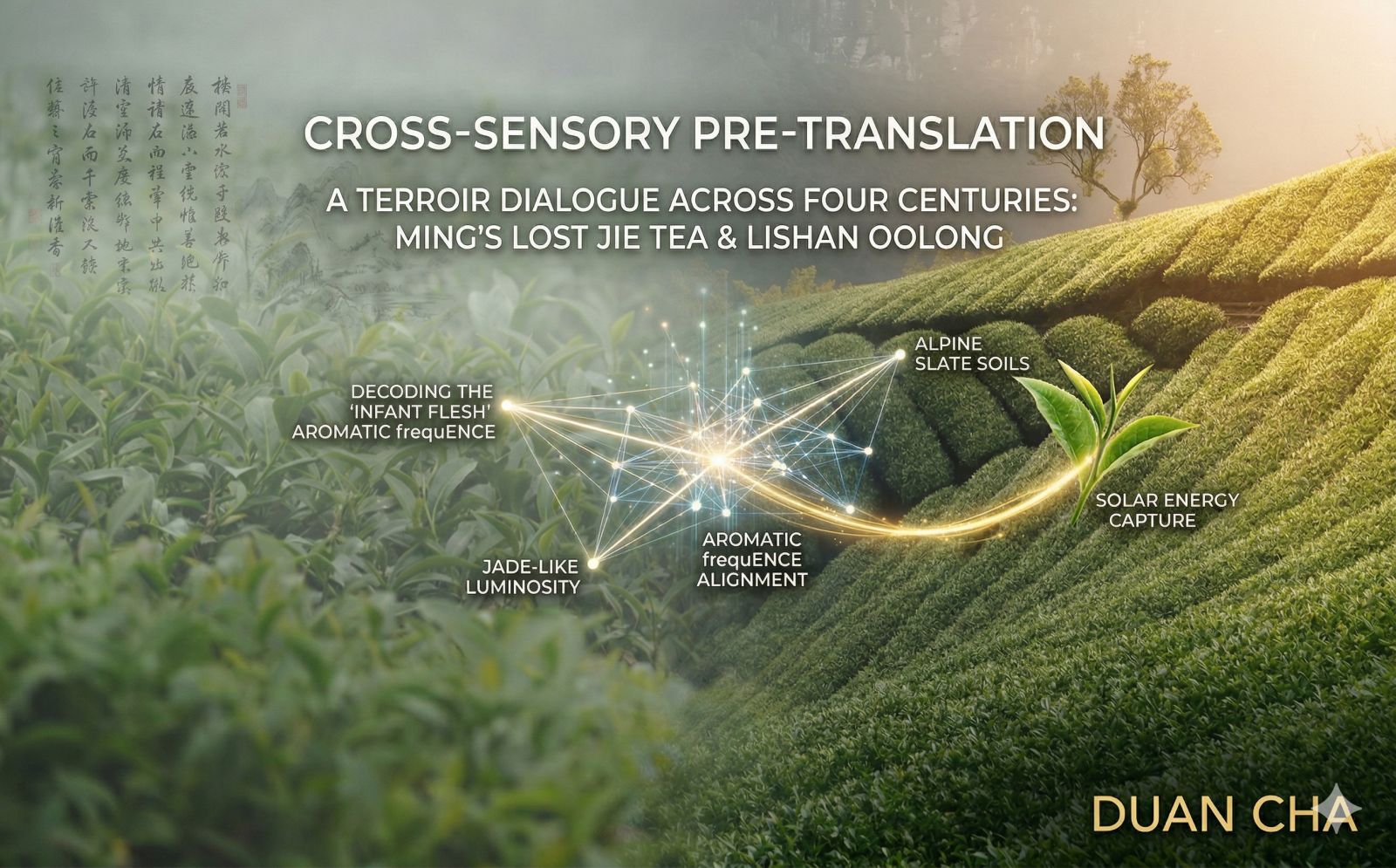
And yet, within the sensory decoding framework of DUAN CHA, an unsettling discovery emerges: The aromatic frequency that once defined Jie Tea never truly disappeared.
Strip away the noise of the modern commercial tea market and ascend into the alpine gardens of Taiwan’s Lishan Mountains above 2,000 meters, and one encounters a haunting familiarity. The spirit of Ming-dynasty Jie Tea appears to reawaken in the modern high-mountain oolong. This is not a coincidence. It is a phenomenon best described as Cross-Sensory Pre-Translation—a terroir alignment across time. When extreme altitude meets absolute minimal intervention, the plant releases the exact same sensory signal: a purity of aroma that resists manipulation and refuses disguise. Across four centuries, two landscapes speak the exact same language.
In the framework of Cross-Sensory Pre-Translation, aroma is never merely scent. It is the brain’s first decoding command. Before the liquid even touches the palate, the olfactory signal already translates into anticipated texture, color, and structure.
1. Rejecting the “Moss-Green Illusion” Modern tea markets often fetishize visual freshness, assuming that the greener the infusion, the better the tea. But Ming tea scholar Zhou Gaoqi dismissed this outright. Tea that appears bright moss-green, he argued, is often a superficial aesthetic—a visual noise rather than a sensory truth. The finest teas, instead, possess a subtler luminosity. He described the greatest Dongshan Jie Tea as yielding a liquor that is "pale yet luminous, its tone like jade—tender green even in winter, sweet yet delicate, pure in resonance and gentle in breath."
Much like the structural tension found in the world's finest white Burgundies, this indicates clarity rather than color intensity, and an inner luminosity rather than surface brightness. When a minimally processed Lishan high-mountain oolong is brewed today, the rising aroma—often reminiscent of cool orchid and alpine florals—produces a similar sensory cue. Even before tasting, the nose predicts the palate: a texture silken, restrained, and mineral-polished, untouched by excessive heat or aggressive processing. Both teas reject superficial “green intensity” and instead express the quiet glow of jade-like translucence.
2. The “Infant Flesh Aroma” Perhaps the most startling yet biologically precise descriptor recorded by Zhou Gaoqi is the phrase: “infant flesh aroma” (嬰兒肉香). To modern Western readers, the metaphor might seem jarring, but within a sensory framework, it perfectly captures the essence of uncorrupted vitality.
Sharing the vocabulary of pristine organic viticulture, it suggests a fragrance free of smoke, oxidation, or vegetal harshness. From a biochemical perspective, such aromas correspond to high concentrations of free amino acids and delicate esters, preserved by minimal oxidative by-products. Today, Lishan’s alpine environment—cool, mist-covered, and remote—allows tea leaves to develop precisely these characteristics. The aroma announces purity before the palate confirms it, immediately translating into a silken texture, a weightless sweetness, and a complete absence of bitterness.
No sensory phenomenon exists without terroir. For Cross-Sensory Pre-Translation to occur, the environmental signal must first be encoded into the plant itself. Remarkably, the terroir conditions of Ming-era Jie Tea and modern Lishan tea show striking parallels.
1. Solar Exposure and Energetic Structure Ming tea masters obsessed over site selection. Zhou Gaoqi insisted that the finest tea gardens faced southern exposure, maximizing sunlight capture. Sharing the physiological rhythm of great viticulture, this reflects a sophisticated understanding of solar energy and plant metabolism, where the plant stores sunlight as structural extract.
Today, Lishan’s highest tea gardens mirror this strict discipline. At elevations above 2,000 meters, ultraviolet radiation intensifies, diurnal temperature shifts become extreme, and roots are forced to penetrate deep slate and shale soils. The resulting leaves carry an enormous, undeniable terroir energy.
2. Aromatic Minerality Ancient texts describe the finest Jie Tea as growing “among rocks,” producing aromas described poetically as floating fungal or orchid fragrances. This corresponds closely to what modern critics describe as minerality.
When Lishan tea is infused, the aromatic lift constructs an immediate landscape: the cool alpine air, the scent of distant conifer forests, and the austere silence of high mountains. The nose constructs a geography. Just as a great Riesling can conjure slate cliffs, Lishan oolong evokes stone, mist, and altitude. The aroma is not merely floral; it is geographical.
The final parallel between Jie Tea and Lishan tea lies in their relationship with time, a defining metric for any world-class beverage.
1. Refusal of Premature Harvest While most commercial markets celebrate early harvests, historical records show that Jie Tea was deliberately picked later. Because the climate was cold, growers waited until the leaves reached full physiological maturity. Echoing the concept of phenolic ripeness in fine wines, the resulting tea possessed greater density and structure.
Modern Lishan tea follows the exact same rhythm. Spring harvests frequently occur as late as May, allowing the leaves to accumulate deeper flavor reserves. The sensory outcome is an unmistakable increase in palate density, a deeper mid-palate resonance, and a much longer aromatic persistence.
2. Aging and Aromatic Expansion A fascinating Ming record describes a test of authenticity: After months of storage, true Jie Tea would develop an even stronger fragrance, while inferior teas faded.
Great terroirs evolve; mediocre ones collapse. Top Lishan teas show a similar resilience. Properly stored, their aroma does not diminish with time but rather deepens, revealing layered notes of alpine florals, honeyed sweetness, and quiet mineral depth. The finish lengthens, and the structure becomes more integrated, demonstrating exceptional aging potential.
Jie Tea did not disappear. It simply awaited another landscape capable of expressing its spirit.
Through the lens of Cross-Sensory Pre-Translation, Taiwan’s Lishan high-mountain oolong emerges not as an imitation of Ming tea—but as its natural successor in terroir expression. When the cup releases aromas described centuries ago as “infant flesh” or “floating orchid fragrance,” the experience becomes something far more profound than tasting. It becomes sensory archaeology.
Across four hundred years, the same aromatic signal travels through time. The nose receives it. The brain translates it. And suddenly, the vanished flavor of Ming China reappears—not in ancient texts, but in the mist-covered mountains of Taiwan, quietly waiting to be rediscovered.


