


2026年03月16日
Across the long history of tea in East Asia, tea and Zen have always shared a quiet resonance. From the Tang and Song dynasties onward, tea prepared in monasteries already carried the atmosphere of spiritual practice.
Yet the most delicate traces of Zen do not always lie in the riddles of the temple. Sometimes they appear in more ordinary places—in the daily utensils of Ming-dynasty scholars.
The tea writer Mao Xiang left behind a passage in his Compendium of Jie Tea that reads almost like a philosophical fragment:
“The teapot should be small. Each guest should have a pot of their own and pour for themselves. Only then does the pleasure of tea emerge.
Why? A small pot keeps the aroma from dispersing, and the flavour does not linger too long.
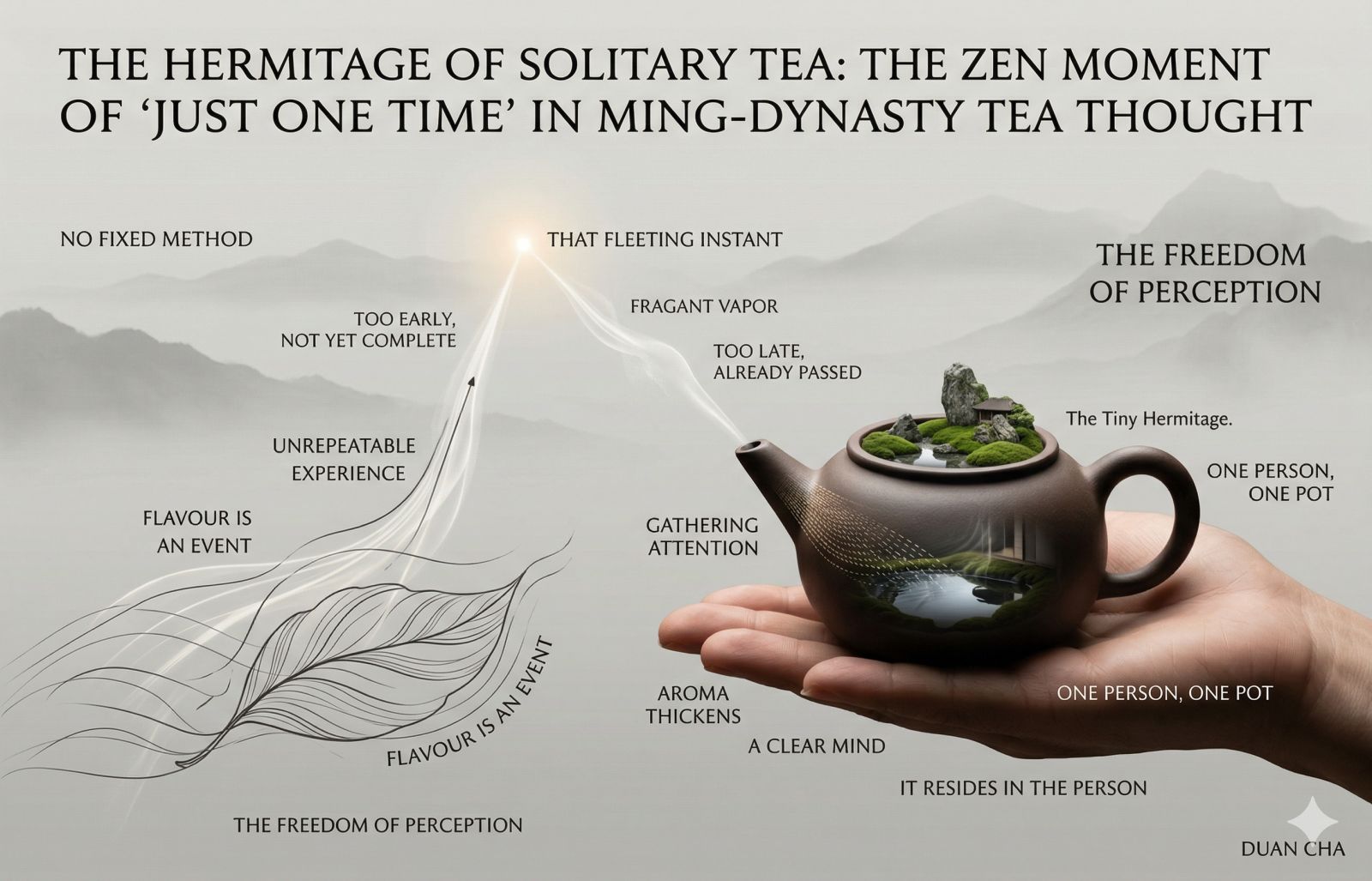
The fragrance and taste of tea arrive neither early nor late; they exist for a single moment. Too early, and they are not yet complete. Too late, and they have already passed.
In that fleeting instant, drink with a clear mind. Adapt and judge according to the moment—it resides in the person.”
These few sentences read like the sudden strike of a wooden staff in a Zen hall.
They disperse the chatter of social tea gatherings. They dissolve our attachment to time. And they turn the act of drinking tea—from a bodily habit of thirst—into a quiet form of inner observation.
In the ordinary world, tea gatherings often function as social rituals. Tea becomes the medium through which conversation flows.
From a Zen perspective, however, such outward attention easily becomes distraction.
Mao Xiang begins with a rule that feels almost austere:
“The teapot should be small. Each guest should have a pot of their own.”
On the surface, this is merely a matter of utensils. But beneath it lies a subtle architecture of attention.
In Zen practice, concentration begins by reducing external stimuli. A large communal pot inevitably invites distraction: the etiquette of pouring, the choreography of serving, the polite rhythms of conversation.
A small pot does something different. It withdraws the drinker from the social field and returns their attention inward.
Held within the palm of the hand, the teapot becomes a tiny hermitage—a secluded chamber where perception can settle.
“A small pot keeps the aroma from dispersing.”
Physically, this preserves the fragrance of tea. Yet metaphorically it describes something else: the gathering of attention.
When space contracts, intensity grows. Aroma thickens. Perception sharpens.
Only in such a quiet field of attention can the subtle language of tea begin to appear.
The most striking sentence in Mao Xiang’s passage is this:
“The fragrance and taste of tea exist for a single moment.”
Too early, and they have not yet arrived.
Too late, and they have already gone.
In Zen philosophy, all phenomena share the nature of impermanence. Tea reveals this truth with remarkable clarity.
The instant hot water meets the leaves, an intricate transformation begins. Aromatic molecules rise and dissipate. Sugars dissolve. Bitterness softens and returns.
The flavour of tea is not a stable object.
It is an event unfolding in time.
Mao Xiang reminds us that the most exquisite expression of a tea may appear only briefly—a flash rather than a state.
Miss that instant, and the moment is gone.
Zen teachings often repeat a simple idea:
the past cannot be grasped, and the future has not yet arrived.
Tea demands the same discipline.
If the drinker is preoccupied with the previous infusion, or anticipating the next, the moment passes unnoticed. But if the mind settles fully into the present—into what Mao Xiang calls “that single instant”—then the tea reveals itself completely.
The experience resembles the sudden insight described in Zen texts: an awakening that occurs not through effort, but through perfect timing.
Zen masters often dismantle their own teachings. In doing so they reveal a deeper principle: there is no final method.
Tea, too, eventually leads to this freedom.
Mao Xiang ends his reflection with two remarkable words:
“Adapt and judge.”
Modern tea culture sometimes treats brewing like a laboratory experiment: precise temperatures, precise seconds, precise measurements.
Yet Mao Xiang suggests something subtler.
The conditions of every moment are different.
The weather shifts. Humidity changes. Even the drinker’s own breathing and heartbeat alter perception.
No fixed formula can account for these living variables.
To brew tea well is therefore not to follow a rule but to respond to the moment.
Technique gradually dissolves into intuition.
“In that instant, drink with a clear mind.”
Tea itself carries no emotion. It simply reflects the condition of the drinker.
If the mind is restless, the tea feels dull. If the mind becomes quiet, the tea opens.
In this sense the cup becomes a mirror.
Mao Xiang concludes with a simple phrase:
“It resides in the person.”
A thousand people may drink the same tea, yet each will encounter something different. One tastes only refreshment. Another senses the cool air of distant mountains. A third glimpses, in the shifting balance of bitterness and sweetness, a reflection of life itself.
Both tea and Zen ultimately lead toward solitude—not loneliness, but an experience that cannot be transferred.
It can only be lived.
There is no universal answer hidden in the cup.
And perhaps that is precisely the point.
The absence of a fixed answer is itself the answer of tea.


