


2026年04月20日
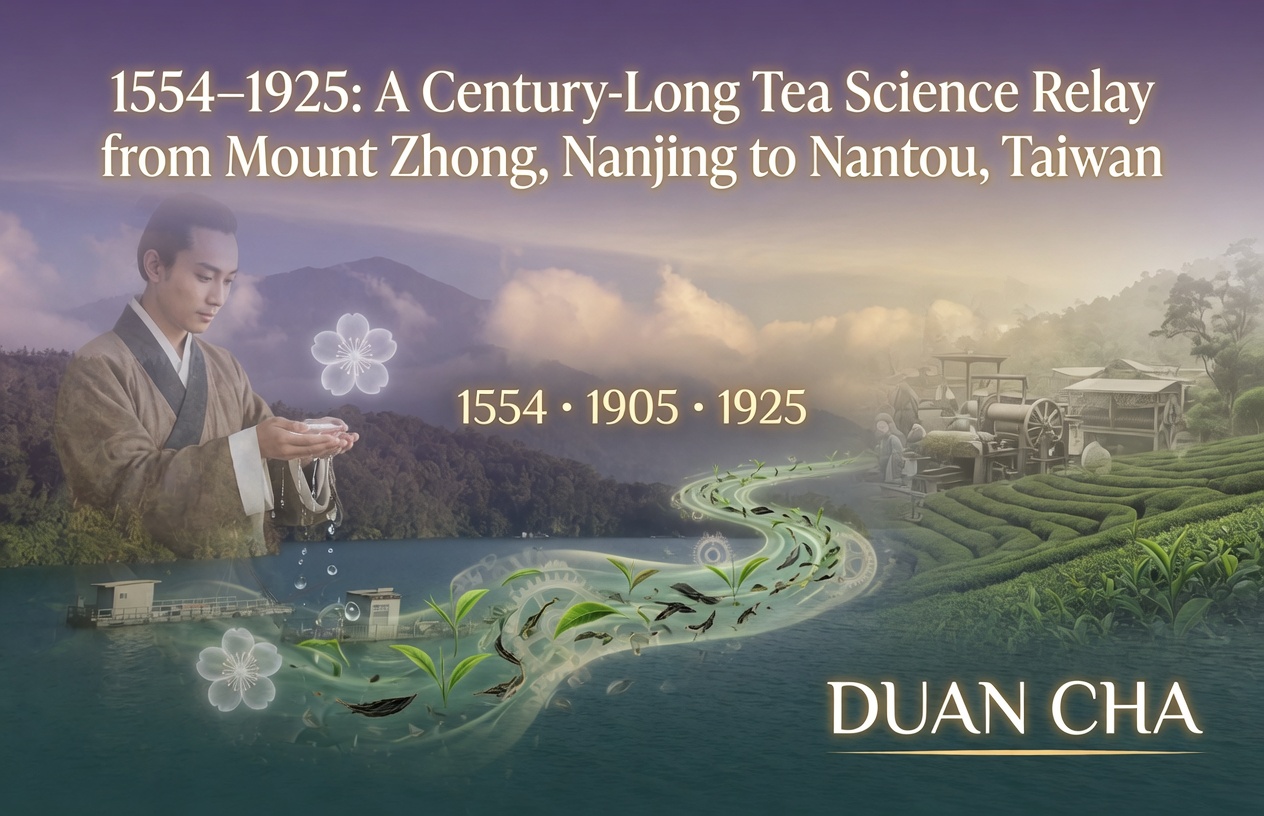
In the long river of global tea history, certain locations are destined to become confluences of civilization. Mount Zhong (Zijin Mountain) in Nanjing is one such place. The journey began in the 33rd year of the Jiajing era of the Ming Dynasty (1554), when Xu Xianzhong captured the spiritual essence of water. It continued into the 31st year of the Guangxu era of the Qing Dynasty (1905), when Zheng Shihuang introduced the roar of machinery to its slopes. Finally, in 1925, this lineage crossed the strait to take root in Yuchi, Nantou, Taiwan. Spanning 371 years, this relay connects the ultimate sensory refinement of scholars at one end with the industrial salvation of a nation at the other. Throughout it all, the vessel of this history has remained a single ladle of "heavy" water.
The mid-Ming Dynasty was a formative period when Chinese tea culture shifted entirely from "whisked tea" (dian cha) to "infused tea" (pao cha). During this era, the obsession with water reached its zenith. In 1554, Xu Xianzhong authored The Complete Compendium of Water Qualities (Shui Pin Quan Zhi). In its final volume, he recorded an enchanting observation:
"At the northern slope of Mount Zhong, there is Plum Blossom Water. When scooped by hand and let fall, every drop forms the shape of a plum blossom. This is due to the richness and heaviness of the 'stone milk' (mineral essence)—a truly singular marvel."
This record is more than literary romance; it is a precise physical observation. What Xu described as "heavy stone milk" is understood by modern science as a high concentration of minerals (calcium and magnesium ions), or what we call "hard water." This water possesses extremely high surface tension, allowing droplets to maintain their shape rather than scattering—creating the visual wonder of plum blossom petals.
To Xu Xianzhong, the water of Mount Zhong was a vessel for lingqi (spiritual essence). At that time, tea was primarily green tea (loose leaf), and a balance was struck between the "heaviness" of the water and the "clarity" of the tea. He was not merely tasting water; he was establishing a standard for the natural world, seeking the purest order of the Ming Dynasty within a single spring. This marked the beginning of "Three Hundred Years of Water"—the first identification of a constant terroir.
The clock turned to 1905 (the Year of Yisi). The Qing Empire was trembling in the wind, and Chinese tea, which once monopolized the globe, was suffering a devastating blow from the black teas of India and Ceylon.
That year, Zhou Fu, the Governor-General of Liangjiang, dispatched Zheng Shihuang—an expectant Taotai of Jiangsu—to lead a mission to India and Ceylon. This expert, hailed as the "first official to go abroad to investigate tea," wrote a heartbreaking observation in his diary:
"The tea of India and Ceylon is heavy in flavor and low in price; Westerners have already become accustomed to it... Although Chinese tea possesses superior aroma, it is no longer sought after."
Zheng realized that Chinese tea was losing due to a lack of "mechanization" and "standardization." Upon his return, he did not choose a bustling city center but returned to the foot of Mount Zhong, where Xu Xianzhong had once wandered. Near the Linggu Temple and Pili Stream, he founded the "Jiangnan Tea Plantation Institute."
Why Mount Zhong? Beyond geographical convenience, Zheng’s choice implied an industrialist’s intuition. He intended to promote "mechanized black tea." As a fully fermented tea, the release of black tea's internal substances (theaflavins and thearubigins) relies heavily on the "carrying capacity" of the water. The "heavy stone milk" water discovered by Xu three centuries earlier was exactly what was needed to inspire the "heaviness" required for black tea.
At the foot of Mount Zhong, Zheng installed rolling and drying machines brought back from India. This was the critical turning point of "Three Hundred Years of Tea"—a shift from the sensory elegance of scholars to scientific production and global competition. He reclaimed land, planted tea, and built factories, attempting to use the "Plum Blossom Water" to brew a mechanized black tea that could rival foreign imports. Although the fires of the Xinhai Revolution eventually interrupted this experiment, the seeds of "mechanization" planted at Mount Zhong had already sprouted in the soil of history.
Zheng Shihuang’s struggle in 1905 stemmed from a "lack of organized commerce" and "difficult logistics." However, his conviction that "black tea must be mechanized" and that "production areas must possess specific moisture and soil" found its ultimate answer in Taiwan twenty years later.
In 1925 (the 14th year of the Taisho era), a systematic black tea trial-planting project began. This time, investigators looked beyond the small-leaf Oolong regions of the north and turned their gaze toward Yuchi in Nantou, central Taiwan.
The historical coordinates overlapped in a startling way:
The Resonance of Moisture: The area around Sun Moon Lake in Yuchi experiences frequent morning and evening mists, high humidity, and significant temperature fluctuations. This "heavy" atmospheric environment mirrored the "heavy" mineral quality of Mount Zhong's water in its sensory performance.
The Relay of Technology: In 1926, technical experts confirmed that Yuchi was the ideal location to introduce the Indian Assam large-leaf variety—the very variety Zheng Shihuang had championed in 1905.
The Completion of Industry: In 1936, the Yuchi Black Tea Experimental Branch was formally established.
From Mount Zhong in Nanjing to Maolan Mountain in Yuchi, Nantou, this was a great geographical discovery of "heavy terroir suitable for black tea." Though the technicians were of a different era and nationality than Zheng Shihuang, their obsession with "heavy water" and "mechanized tea" was identical in the eyes of tea science.
When we align the temporal coordinates of 1554, 1905, and 1925, a quiet yet startling truth emerges: while tea varieties change with the fate of nations, the spirit of "investigating things to extend knowledge" (gewu zhizhi) remains constant, seeking a water-vein creation that never shifts.
I. The Constancy of Creation: A Thousand-Year Watch of the Water-Vein (Three Hundred Years of Water)
Xu Xianzhong defined the "logic of creation" for Mount Zhong's water. No matter how human eras change, the "stone milk" quality that provides body to the tea soup and lets a drop form a plum blossom remains the bedrock of quality. This identification of "heavy" water is the physical foundation of all tea logic, transcending regime changes to guard the final line of botanical spirituality.
II. The Evolution of Aspiration: From Mountain Spirituality to Global Trade (Three Hundred Years of Tea)
From the clear green loose-leaf tea seeking harmony between heaven and man in Xu Xianzhong’s Ming Dynasty writings to the mechanized black tea promoted by Zheng Shihuang for national strength, tea has evolved with the urgency of the times. It shifted from an elegant hobby of scholars to a vital industry competing in global trade. Though machinery has grown complex, the core remains: using professional observation to transform the energy of a terroir into a sensory product that carries national dignity.
III. The Handing Down of the Torch: A Confluence of Truth Across Eras
This long relay is essentially a spiritual resonance between generations of "investigators" across different times and spaces. Xu Xianzhong, amidst the incense of the Ming Dynasty, used his scholar-official’s sensitivity to pinpoint the spiritual essence of Mount Zhong’s water. Zheng Shihuang, amidst the storms of the late Qing, took up the mandate of Chinese tea with the courage of a statesman. Finally, the pioneers who labored in the mountain forests of Taiwan completed the final puzzle of terroir with the same rigorous eye.
Though they lived in different eras, they shared a stubborn ambition: a refusal of ambiguity and a rejection of blind tradition. They guarded a sincere "insight into the logic of all things," an obsession that elevated a love for plants into a precise and definitive science.
Under this lineage, tea is no longer just a luxury in a cup or a matter of commercial profit and loss; it is the most serious and profound dialogue between man and creation. In the "heavy" water and the "fermentation" logic, they found a set of truths that did not shift with the changing of regimes. This spirit is the true nectar worth sipping and remembering in 2026.
Today, whether we stand in the tea gardens of Yuchi, Nantou, or walk near the Linggu Temple of Mount Zhong, that "heavy" essence still lingers.
For those of us immersed in the fragrance of tea today, this 371-year-old flame reveals a profound truth: culture without the solid foundation of terroir will eventually drift into emptiness; and industry without the sensory care for botanical spirituality will lack soul.
In 1905, Zheng Shihuang lamented: "If Chinese black tea is not improved, there will be no day for its export in the future." These words remain thunderous 121 years later. In the brand practice of DUAN CHA, our commitment to "1391 Zero-Intervention" and "Cross-Sensory Pre-Translation" is a modern, sensory form of "tea improvement." We seek to regain Xu Xianzhong’s reverence for terroir while applying Zheng Shihuang’s insistence on standards and mechanism.
This is a pot of tea that has been brewing for 371 years. From the plum blossoms of Mount Zhong to the investigations in India and the mists of Taiwan, every drop of water carries a history of tea, and every leaf records an innovation. When we lift our cups, we drink not only a flavor but a century-long tea path forged by tea experts across time.


